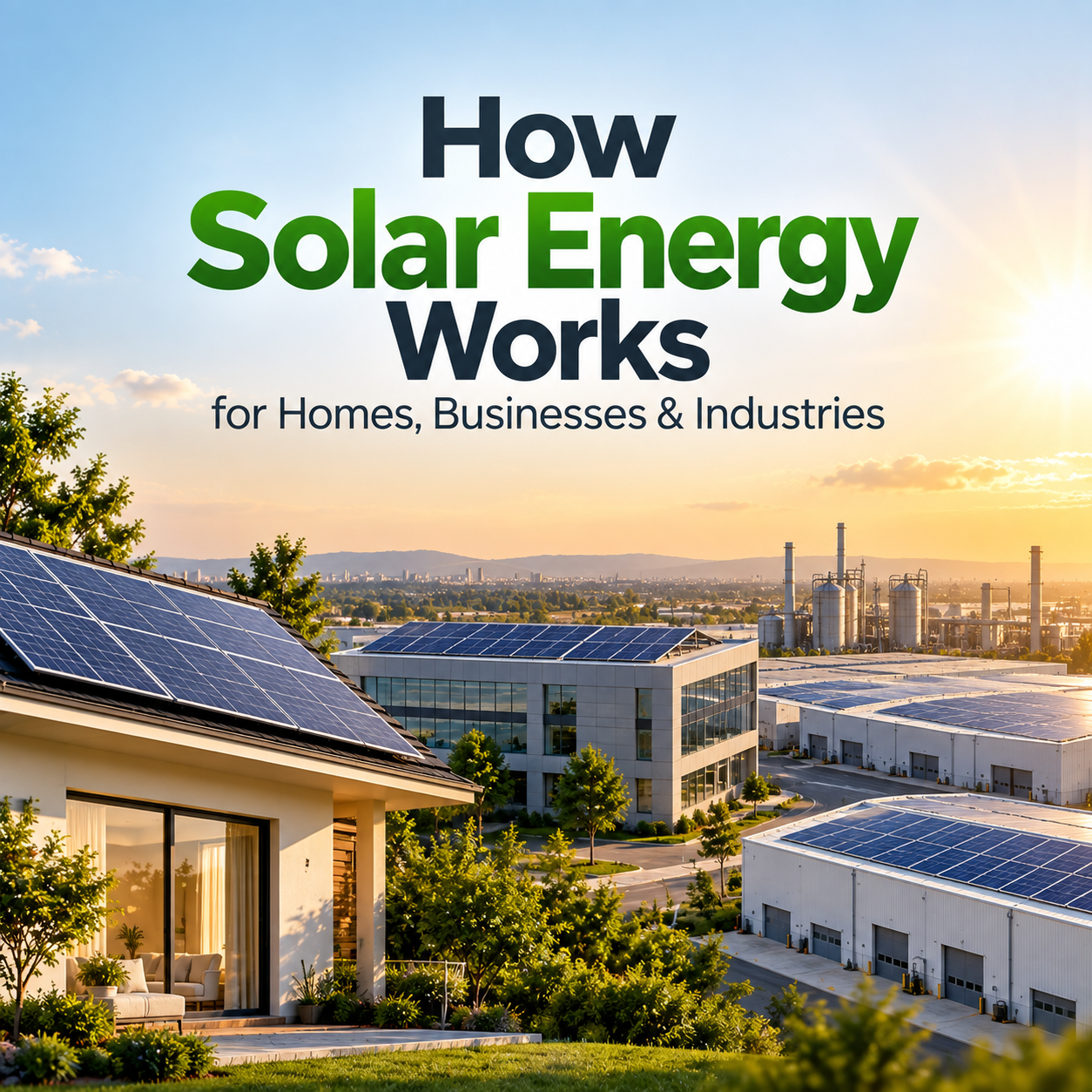
How Solar Energy Works for Homes, Businesses & Industries: A Complete Guide to Solar Solutions
Solar energy has moved far beyond being an alternative source of electricity. Today, solar power is being considered by homeowners, businesses, factories, institutions, farmers, and large infrastructure projects looking for a smarter way to manage their energy requirements. But solar is not a single solution.
A home may need a rooftop solar system. A factory may require a large industrial installation. A farm may benefit from a solar water pump, while a commercial organisation may need a complete EPC solution and ongoing maintenance.
Understanding these options is the first step towards choosing the right solar system.
How Does Solar Energy Work?
Solar panels contain photovoltaic cells that convert sunlight into electrical energy. When sunlight reaches the panels, the photovoltaic cells generate electricity. The system then uses an inverter and associated electrical equipment to make that electricity suitable for the intended application.
A typical solar installation may include:
- Solar PV modules
- Inverter
- Mounting structure
- DC and AC cables
- Protection equipment
- Earthing
- Monitoring system
- Electrical connections
The exact system configuration depends on the project.
Residential Rooftop Solar
For homeowners, rooftop solar is one of the most practical ways to use available roof space for electricity generation.
A residential rooftop system can be designed according to:
- Household electricity consumption
- Available roof area
- Roof structure
- Sunlight availability
- Electrical requirements
- Grid connection
It can be suitable for independent houses, bungalows, villas, and other eligible residential properties.
Why Are Homeowners Choosing Rooftop Solar?
One major reason is the opportunity to generate electricity closer to where it is consumed.
Other potential advantages include:
- Better use of unused rooftop space
- Reduced dependence on conventional grid electricity
- Renewable power generation
- Lower long-term electricity expenses
- Reduced environmental impact
For eligible residential consumers, government programmes may also provide financial support subject to current rules and eligibility requirements. The Ministry of New and Renewable Energy provides official information on rooftop solar programmes and applicable assistance.
Commercial Solar Solutions
Businesses consume electricity for lighting, cooling, machinery, computers, refrigeration and many other operations.
For commercial facilities, solar can become part of a broader energy-management strategy.
Commercial solar can be considered for:
- Offices
- Hotels
- Hospitals
- Schools
- Warehouses
- Retail facilities
- Institutions
- Commercial buildings
The system can be designed around the facility's electricity consumption and available installation area.
For a business, the important question is not simply how many panels can fit on the roof.
It is about finding the right balance between electricity consumption, available space, system capacity, and long-term energy goals.
Industrial Solar
Industrial facilities often operate with significant electrical loads. Factories and manufacturing units may use electricity for machinery, motors, compressors, HVAC systems, lighting, and other production requirements. Industrial solar projects therefore require detailed technical planning.
Important considerations can include:
- Roof or ground availability
- Structural capacity
- Electrical infrastructure
- Load profile
- Inverter selection
- Cable routing
- Protection systems
- Transformer integration
- Monitoring
- Safety
- Maintenance
A properly designed industrial solar system should fit into the facility's existing electrical environment rather than being treated like an oversized residential system.
Solar Water Pumps
Solar water pumping is another important application of solar energy. Instead of relying completely on conventional electricity or diesel, solar power can be used to operate water pumps. This can be particularly useful for agricultural and remote applications.
Solar water pumps can be considered for:
- Agricultural irrigation
- Farms
- Water supply
- Remote locations
- Areas with unreliable grid electricity
The system can include solar panels, a pump controller, a water pump, a mounting structure, and associated electrical equipment. The appropriate pump and solar capacity depend on factors such as water requirement, pumping depth, flow rate, and application.
Government programmes such as PM-KUSUM also support certain solar-powered agricultural applications, subject to scheme guidelines and state-level implementation.
What Is Solar EPC?
EPC stands for Engineering, Procurement and Construction.
A solar EPC service provides an end-to-end approach to project execution.
Instead of coordinating separate companies for design, equipment procurement, and installation, the project can be managed through one integrated process.
Engineering
This stage can involve:
- Site survey
- Energy analysis
- System design
- Layout planning
- Electrical design
- Structural planning
- Equipment selection
Procurement
The required solar equipment is sourced according to the approved design.
This can include:
- Solar modules
- Inverters
- Mounting structures
- Cables
- Protection equipment
- Electrical components
Construction
The installation team then executes the project.
This may include:
- Structure installation
- Solar module installation
- Cable laying
- Inverter installation
- Earthing
- Electrical connections
- Testing
- Commissioning
The advantage of an EPC approach is that the different stages are coordinated as part of one project.
Why Solar O&M Matters
Installing solar panels does not mean the system can simply be forgotten. Regular Operation & Maintenance (O&M) can help identify performance issues before they become larger problems.
Solar O&M may include:
- Module inspection
- Cleaning
- Inverter checks
- Electrical inspection
- Performance monitoring
- Preventive maintenance
- Fault identification
- Corrective maintenance
- Safety checks
Dust, debris, shading, and equipment faults can affect system performance. Regular monitoring can help identify unusual changes in generation and allow corrective action.
Solar for Different Needs
One of the biggest advantages of solar technology is its flexibility.
For a Home
Residential rooftop solar can use available roof space to generate electricity.
For a Business
Commercial solar can become part of a company's long-term energy strategy.
For a Factory
Industrial solar can be designed around larger electrical loads and industrial infrastructure.
For Agriculture
Solar water pumps can provide an alternative way to power irrigation and water pumping.
For Large Projects
Solar EPC can provide integrated engineering, procurement, and construction services.
For Existing Solar Plants
O&M services can support ongoing performance, inspection, and maintenance.
What Should You Check Before Installing Solar?
Before starting a solar project, consider more than the number of panels.
Electricity Consumption
Understand how much electricity the property actually uses.
Available Space
Check whether sufficient roof or ground space is available.
Shading
Nearby buildings, trees and structures can affect solar generation.
Roof Condition
For rooftop projects, the condition and structural suitability of the roof should be assessed.
Electrical Infrastructure
The existing electrical system needs to be considered before integration.
Future Electricity Requirements
If electricity consumption is expected to increase, the system design should take future requirements into account.
Maintenance
Understand who will monitor and maintain the system after installation.
Why Professional Solar Installation Matters
Solar is a long-term infrastructure investment. A professionally designed system considers the entire project instead of focusing only on the panels. Engineering, equipment selection, installation quality, safety, monitoring, and maintenance all contribute to the performance of the system. This is particularly important for commercial and industrial projects, where electrical requirements can be considerably more complex.
Solar Is More Than Installing Panels
- The future of solar energy is not simply about putting panels on rooftops.
- It is about creating complete energy solutions.
- For one customer, that may mean residential rooftop solar.
- For another, it may be commercial or industrial solar.
- For an agricultural application, a solar water pump may be the right solution.
- For a large project, an EPC approach may be more suitable.
- And once the system is operating, professional O&M can help maintain its performance.
Final Thoughts
Solar energy can serve very different purposes depending on where and how it is used. From residential rooftop solar and commercial solar to industrial solar, solar water pumps, solar EPC, and solar O&M, each application requires its own approach. The right solar solution begins with understanding the customer's electricity consumption, site conditions, future requirements, and operational goals.
Instead of asking, “Which solar panel should I buy?”, a better starting point is: “What solar solution is right for my property and energy requirement?”
With proper site assessment, engineering, installation, and ongoing maintenance, solar can become a practical part of a home's, business's, or industry's long-term energy strategy.